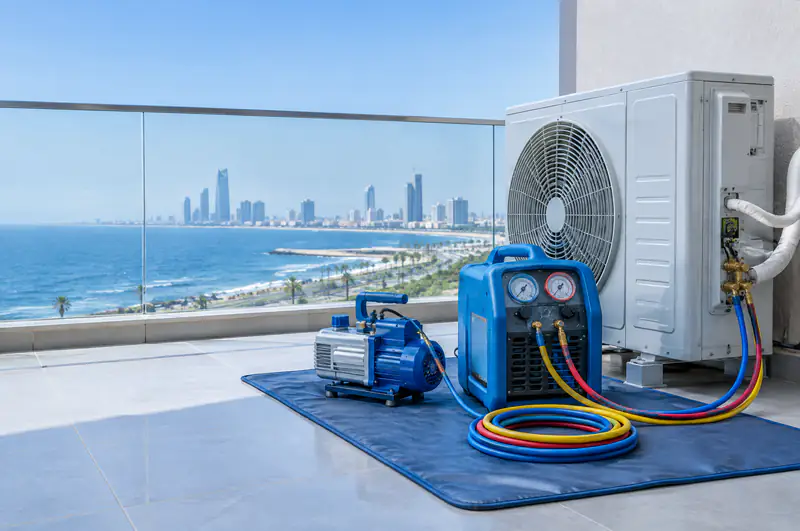

Find the leak first
Refrigerant charging in Al Manarat
In Al Manarat, far north Jeddah, large villas and upscale residential complexes rely on complex AC systems with very long copper runs. Refrigerant charging here requires precise leak detection and repair before filling, since large systems cannot tolerate error.
- Leak located
- Vacuum and test
- Accurate charge
Clients We're Proud to Serve
Organisations and companies that trusted Alrabih with their projects.



































Signs the charge is low
- 1
Weak cooling and a compressor that runs on
The unit runs for hours without bringing the temperature down, or cools very slowly. This is usually the first sign the charge is low and the circuit can no longer move heat efficiently.
- 2
Frost on the pipes or evaporator coil
Ice on the thin pipe or on the evaporator coil points to low refrigerant pressure. Continued running can damage the coil. Where the frost forms helps the technician narrow down the problem area.
- 3
A refrigerator or cold room that will not hold temperature
In commercial or industrial refrigeration equipment, a rising cabinet temperature means stock at risk. Low refrigerant is one possible cause, and confirming it needs pressure readings and a circuit check on site.
Who it's for
Your window or portable unit cools slowly
We check circuit pressure, locate and repair the leak, then vacuum and charge to the type shown on your unit's nameplate.
Ask on WhatsAppYour cold room or commercial fridge will not hold temperature
We measure pressure, identify why the cabinet temperature is rising, repair any leak found, then charge to the correct refrigerant type for that unit.
Ask on WhatsApp
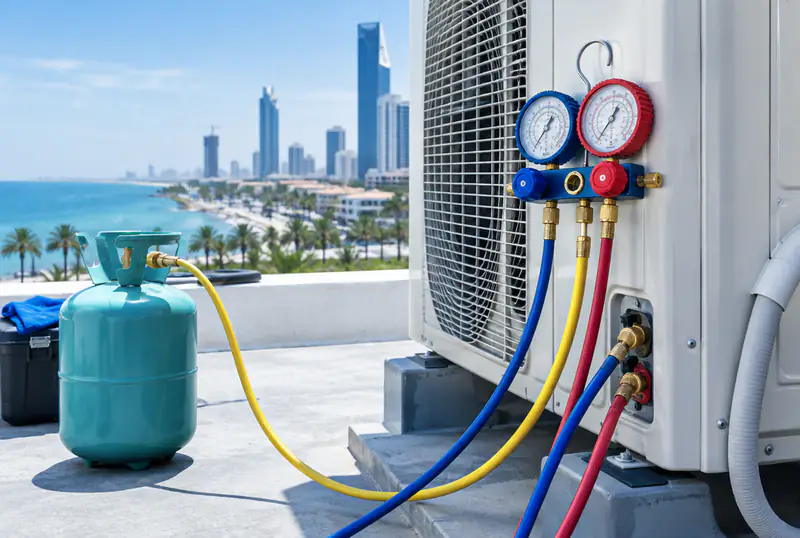
What the work covers
- Pressure check and leak location
- Leak repair before charging
- Vacuum and tightness test
- Charge to nameplate refrigerant
- Run test and performance check
How we work
How we work
- 1
Inspect and locate leak
The technician measures circuit pressure and checks joints and components that corrode in Jeddah's humid, salty air, pinpointing the leak before any other step.
- 2
Repair the leak
The technician repairs the leak point, whether a loose joint, a cracked pipe or corrosion in part of the circuit. The unit is not charged until the repair is confirmed tight.
- 3
Vacuum and pressure test
The circuit is evacuated with a vacuum pump to remove air and moisture, then the reading is watched to confirm pressure holds before refrigerant is introduced.
- 4
Charge and run
The unit is charged to the nameplate type and amount, then run and checked for proper performance on site before handover.
Fix the leak or just top it up?
| Alrabih | The usual way | |
|---|---|---|
| The leak | Found and fixed first | Often ignored |
| Vacuum | Before every charge | Sometimes skipped |
| Refrigerant type | As the nameplate states | May be mixed or swapped |
| Compressor | Protected by correct charge | Worn by wrong charge |
| Refrigeration equipment | AC, fridges and cold rooms | Usually AC only |
Everything your AC needs, from one team
From system design and duct fabrication to installation, commissioning and maintenance.

Split AC installation
Request this serviceDuct installation
Request this serviceCentral AC installation
Request this serviceDuct fabrication
Request this serviceCold room installation
Request this serviceElectro-mechanical works
Request this serviceChiller & AHU installation
Request this serviceHVAC design
Request this serviceAC repair & faults
Request this serviceAC cleaning
Request this serviceRefrigerant charging
Request this serviceCentral AC maintenance
Request this serviceChiller maintenance
Request this serviceAC removal & refitting
Request this serviceDuct cleaning & sanitising
Request this serviceAC servicing by brand
Request this serviceOperation & maintenance contracts
Request this serviceAHU maintenance
Request this serviceFridge & freezer service
Request this serviceCold rooms
Request this serviceDisplay fridges & chillers
Request this serviceFactory HVAC
Request this serviceWarehouse HVAC
Request this serviceVilla & home HVAC
Request this serviceHotel HVAC
Request this serviceSchool HVAC
Request this serviceHospital HVAC
Request this serviceMosque HVAC
Request this serviceMall & retail HVAC
Request this serviceRestaurant & cafe HVAC
Request this service
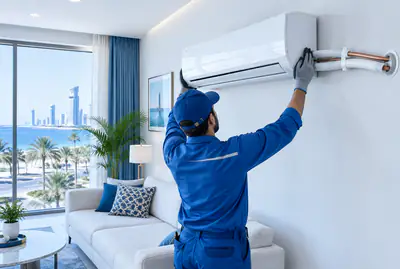
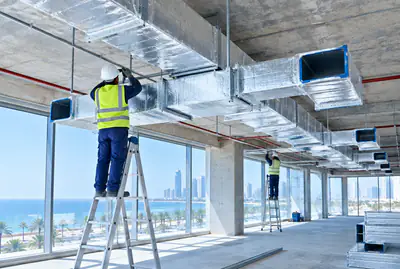



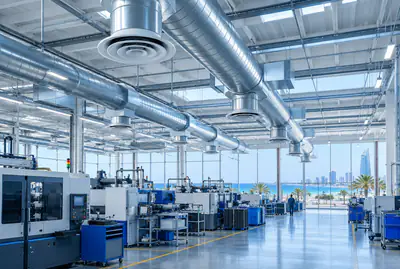








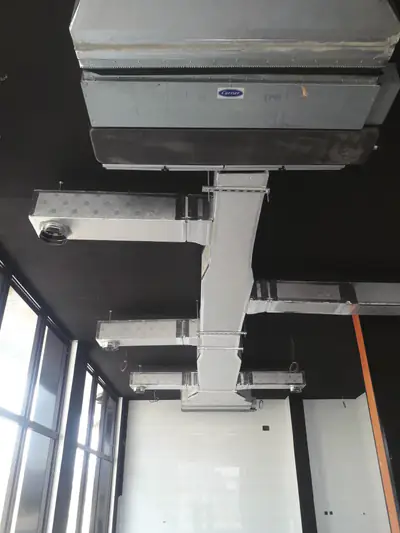
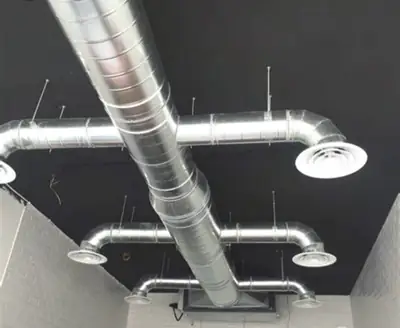
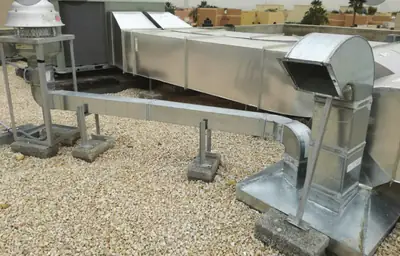
Some of our work
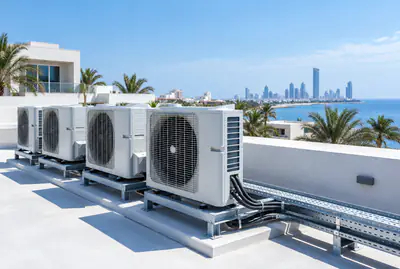
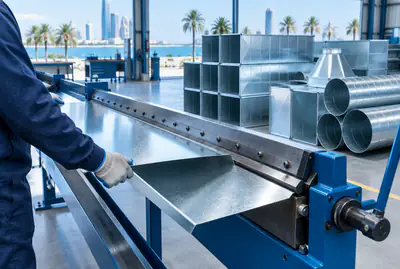
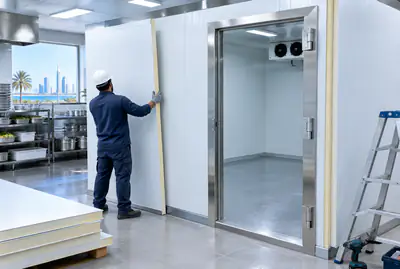
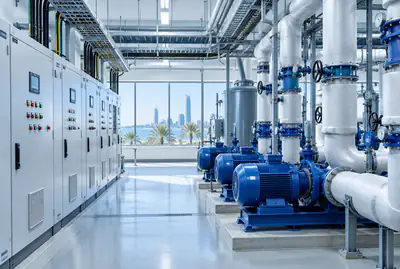
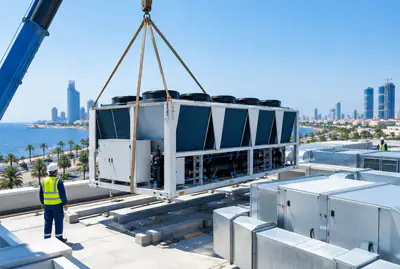
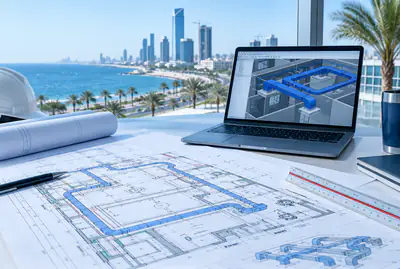
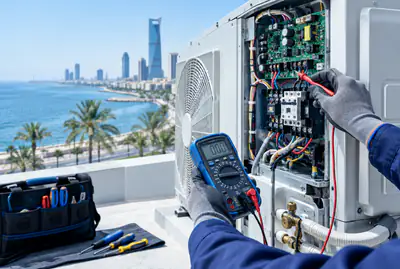
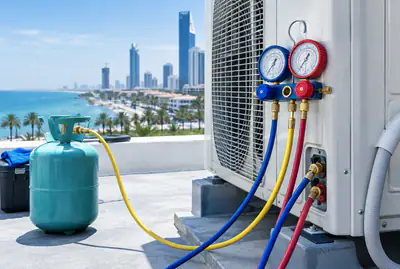
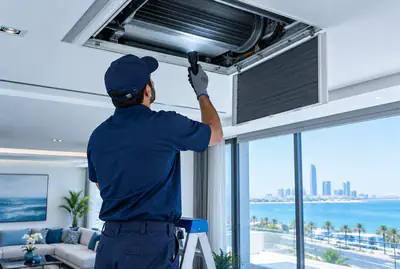
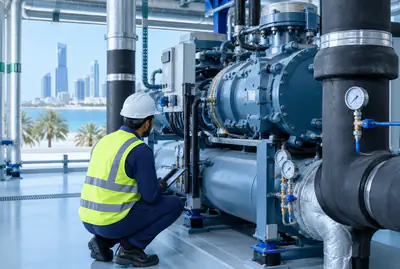
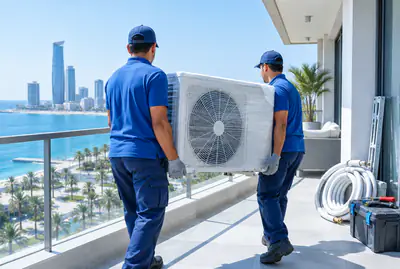
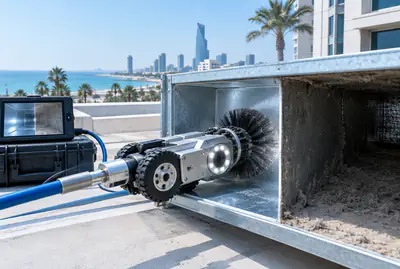
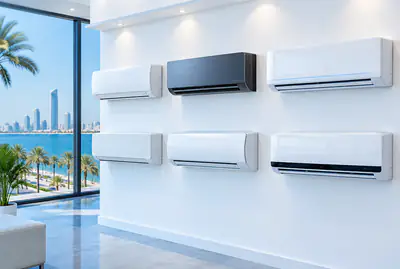
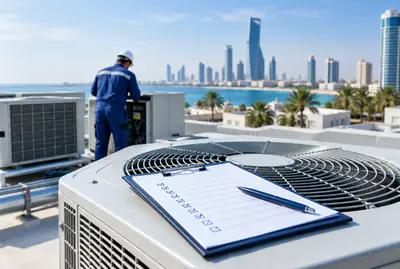
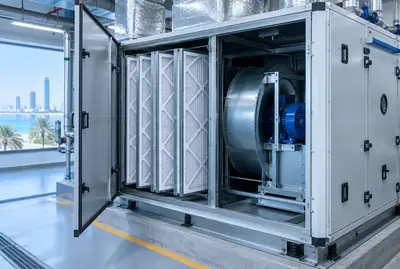
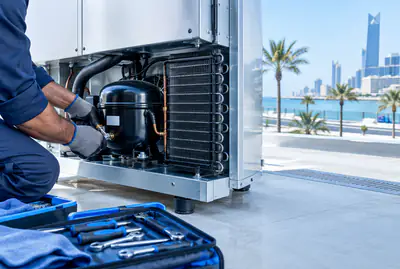
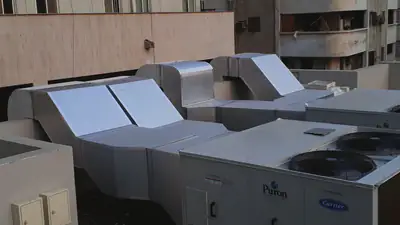
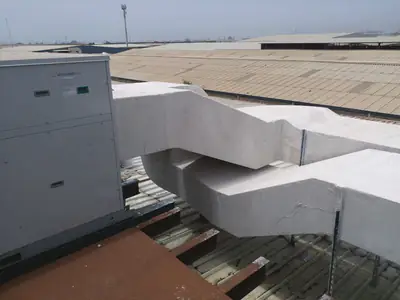
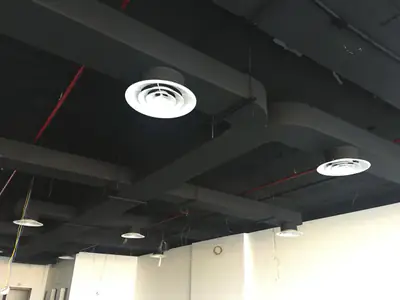
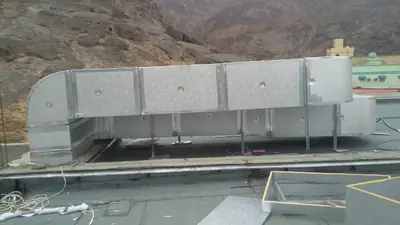
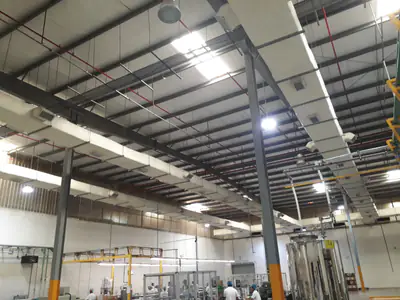
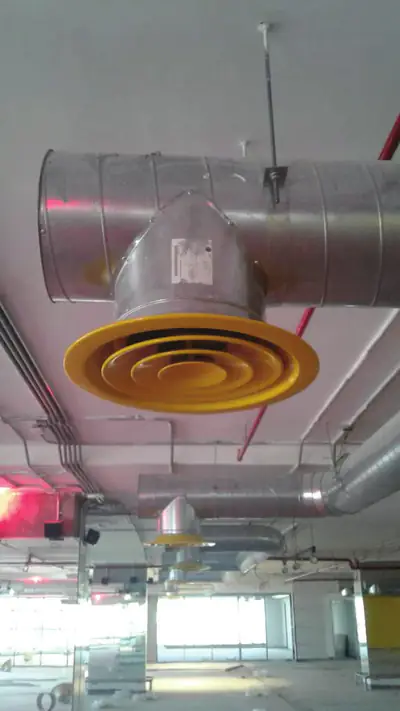
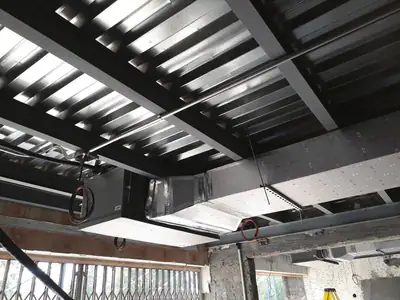
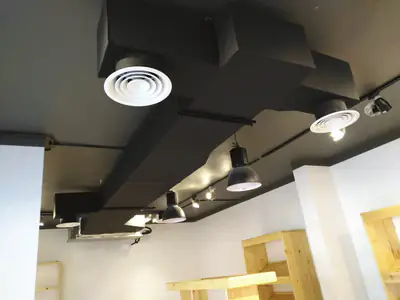
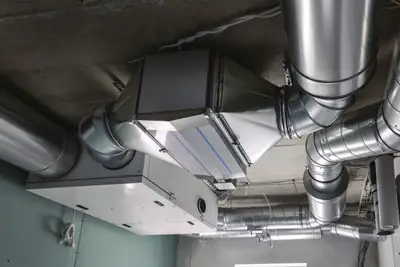
Ductwork, rooftop units and diffusers, from work we've completed in Jeddah.
Customer reviews
What our customers say
- Muhammadramzan 2641
“MashaaAllah. Services are so good. Behaviour and kindness 100/100. Prices are less then Market. Fully recommended”
- shahzeb armani
“Wow. Prices are so comfortable. Outstanding services. People are so talented and nice”
- Tawfik AlyawerLocal Guide
“U can find all u need for air conditioning”
Your satisfaction matters to us! If you had a great experience with us, we'd love a 5-star rating and a kind review.
Worked with us? Leave a reviewService areas
We come to you anywhere in Jeddah
From Al Shiraa and Al Yaqout in the north to Al Thaghr and Al Quraiyat in the south, with our base in Al Aziziyah.

What sets this district apart
Al Manarat is an upscale residential area of large villas and high-quality apartment blocks spread across vast open spaces. Many of these buildings have advanced AC systems, some central ones covering multiple storeys or wings, meaning very long distances between indoor and outdoor units. The intense summer heat and dry air increase circuit pressure, so even a tiny leak can cause rapid refrigerant loss and strain the compressor.
Al Manarat sits in far north Jeddah, an upscale residential district of large villas and apartment complexes across vast spaces.
Most upscale villas and blocks here have central AC units covering multiple storeys, with copper runs often exceeding 50 metres from indoor to outdoor.
The AC setup in Al Manarat
- 1
Central AC covering multiple storeys
Large villas and blocks in Al Manarat use powerful compressor units to distribute cool air across multiple storeys via ducting and long piping.
- 2
Hybrid system with supplementary splits
Some luxury villas have a central system for common areas plus separate split units for private wings and offices.
- 3
Multiple outdoor units spread apart
Massive villas may have two or three outdoor units on separate roofs or distant garden areas, each with its own refrigerant circuit.
Before the visit
Before our visit in Al Manarat
- 1
Provide a system diagram or layout
Tell us exactly where the indoor and outdoor units are located, and if you have a diagram of the piping route it will help our team plan the leak check correctly.
- 2
Ensure access to all piping
Check that all piping routes from indoor to outdoor can be inspected without removing complex obstacles.
- 3
Halt operation before our visit
Turn off the AC at least an hour before we arrive so the circuit pressure drops and our inspection is safer and more accurate.
More districts for Refrigerant charging
Other services in Al Manarat
FAQ
Questions about Refrigerant charging
Can you just add refrigerant without looking for the leak?
A sealed refrigerant circuit does not consume refrigerant. A low charge means there is a leak somewhere. Adding refrigerant without finding and repairing that leak brings the same fault back quickly and can damage the compressor. The correct sequence is always to locate the leak, repair it, pull a vacuum on the circuit, and then charge to the type and quantity shown on the unit's nameplate.
Where does refrigerant leak in commercial refrigeration equipment?
The most common points are expansion fittings and restrictions on the liquid line, flare joints at the evaporator and condenser, and service valves where the rubber seals have aged. In commercial refrigeration, old copper pipe welds weakened by continuous compressor vibration are also a frequent source. The exact location is found during the site inspection.
Does the refrigerant type affect how the unit performs?
Yes. Every unit is designed for a specific refrigerant type with defined operating pressures and heat transfer properties. Using a different type changes those pressures and can either overload the compressor or reduce cooling output. For this reason the unit is always charged with the exact type shown on its nameplate and no substitute is used.
Is the charging work different for a home AC unit and a commercial refrigerator?
Yes, they differ in several ways. Commercial refrigeration units operate at pressures and with refrigerant types distinct from those in air conditioners, and their target temperatures are much lower. The pipe circuits are also longer and often include multiple distributors and valves that require careful inspection before vacuuming and charging. The nature of each circuit determines the procedure.
Is the charging work different for a home AC unit and a commercial refrigerator?
The core steps are the same: locate the leak, repair it, vacuum the circuit, then charge to the nameplate type. Commercial refrigeration units sometimes have additional valves and components that require a different inspection approach. What each unit needs is determined by the technician on site after pressure readings and a circuit check.
The central AC system is very large, does refrigerant leak faster?
Yes, large systems hold more refrigerant, so if there is an active leak the circuit can lose its charge within weeks without fixing the source.
With long distances between units, how do you find the leak?
We use highly sensitive electronic leak detectors and trace the pipe route from indoor to outdoor, and if needed we disconnect sections of tubing to pinpoint the exact leak location.
In hot summer, does the system lose refrigerant faster?
Yes, intense heat raises circuit pressure, so any existing leak will worsen faster during Al Manarat's long hot summer.
After charging, do we need regular checks on the refrigerant level?
If the original leak was properly repaired, the refrigerant should not drop. However, we recommend annual checks for large systems to ensure no new leaks develop.