A common observation among AC owners is that cooling gradually weakens over time, leading many to think of requesting a refrigerant recharge as a quick, routine fix, not unlike topping up a car with fuel every so often. The technical reality is quite different. Refrigerant gas works inside a closed circuit in the unit, and its level is not supposed to drop on its own as long as the circuit stays sealed and intact. When refrigerant actually runs low, the cause is usually a leak somewhere in the circuit, not a natural consumption of the gas as some people assume, and this difference matters because it changes how the problem should be handled from the start.
How the Refrigerant Circuit Actually Works
Refrigerant gas circulates inside a closed loop that includes the indoor unit, the outdoor unit, and the copper piping between them, moving between gas and liquid states to carry heat from inside the space being cooled to the outside, continuously throughout operation. This circuit is designed to stay sealed for the life of the unit, meaning the amount of refrigerant charged at installation is supposed to stay the same without needing repeated top ups, unless something goes wrong in the circuit itself or one of its connections. This applies to any unit regardless of brand, whether Carrier, York, General, Midea, Gree or Smart Gold, since the closed circuit principle works the same way in every case.
Signs That Point to an Actual Leak
Among the clearest signs pointing to a real leak rather than another kind of fault are a gradual, continuous drop in cooling despite the unit running for long hours, a layer of ice or frost forming on the copper line or on the indoor unit itself, and a noticeably longer compressor run time without reaching the temperature set on the thermostat. More than one of these signs appearing together raises the likelihood of a real leak that needs its exact location identified, rather than simply topping up the gas again.
Why Simply Adding Refrigerant Is Not Enough
Adding a fresh amount of refrigerant without fixing the source of the leak is only a temporary fix, because the added amount will gradually escape from the same point the gas leaked from originally, possibly even faster if the gap widens over time. This means the same problem repeats within a relatively short period, with an added cost each time, without ever addressing the root cause. A proper technical inspection looks for the leak location first, whether at a pipe joint or in one of the unit's components, before recharging the circuit with the correct amount specified for that particular model.
Factors That Raise the Chance of a Leak Over Time
Several factors raise the likelihood of a leak developing in the refrigerant circuit as a unit ages, chief among them constant vibration in the outdoor unit due to an unstable mounting surface, and corrosion affecting copper pipe joints from long exposure to moisture and weather in a coastal environment like Jeddah. An impact or friction the pipework is exposed to during other maintenance work in the building, such as electrical or plumbing work near the pipe route, can also gradually weaken a joint's seal without the effect showing up right away.
Cases That Weaken Cooling Without Being a Leak
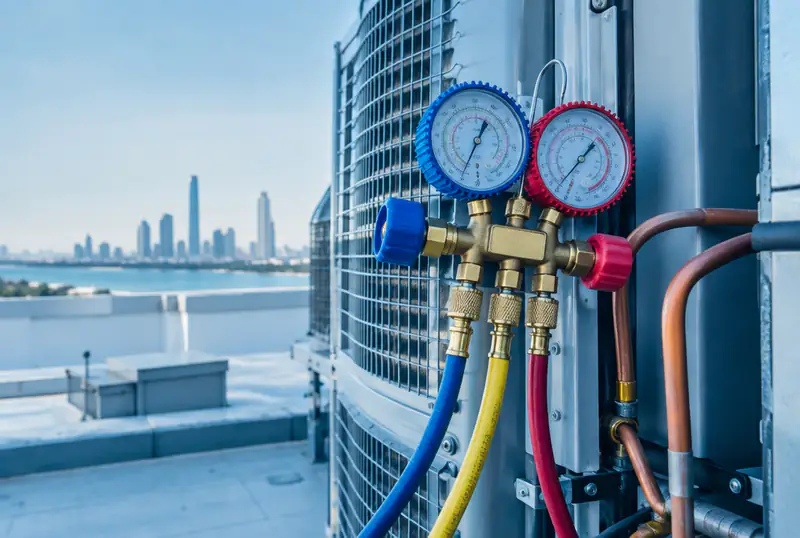
Not every drop in cooling is caused by refrigerant. It could be dirty filters or a dusty outdoor coil, weak airflow due to an obstruction close to the outdoor unit blocking proper ventilation around it, or even a leak in the duct network as covered in signs your AC ducts are leaking cool air. Telling these causes apart needs a direct technical inspection rather than assuming the problem is always refrigerant, since adding gas when the refrigerant has not actually dropped does not solve anything and may strain the circuit unnecessarily. Among the points a technician typically checks during diagnosis:
- Circuit pressure at the suction and discharge points.
- The copper line's temperature compared with normal operation.
- Any trace of oil around pipe joints, a common indicator of where a leak is located.
When an Immediate Inspection Is Worth Requesting
Ignoring a refrigerant leak for a long time strains the compressor, one of the AC's most expensive and sensitive parts, because it keeps running for longer without achieving the cooling required. The earlier a technical inspection is requested through AC repair and faults, the lower the chance of damage reaching the compressor itself, and the simpler and faster the fix compared with waiting for performance to deteriorate completely until the unit stops cooling altogether. Some units also make an unusual sound from the compressor itself when refrigerant drops significantly, an additional signal worth heeding instead of continuing to run a unit clearly short on gas.
Accurately diagnosing the source of the problem is the right first step before any decision to add refrigerant or not, rather than rushing to request a gas recharge every time cooling weakens. Alrabih Innovative Air Conditioning & Refrigeration Solutions offers AC refrigerant charging in Jeddah after inspecting the circuit and identifying the cause of the shortfall, rather than simply adding gas as a temporary fix that does not address the problem at its root.